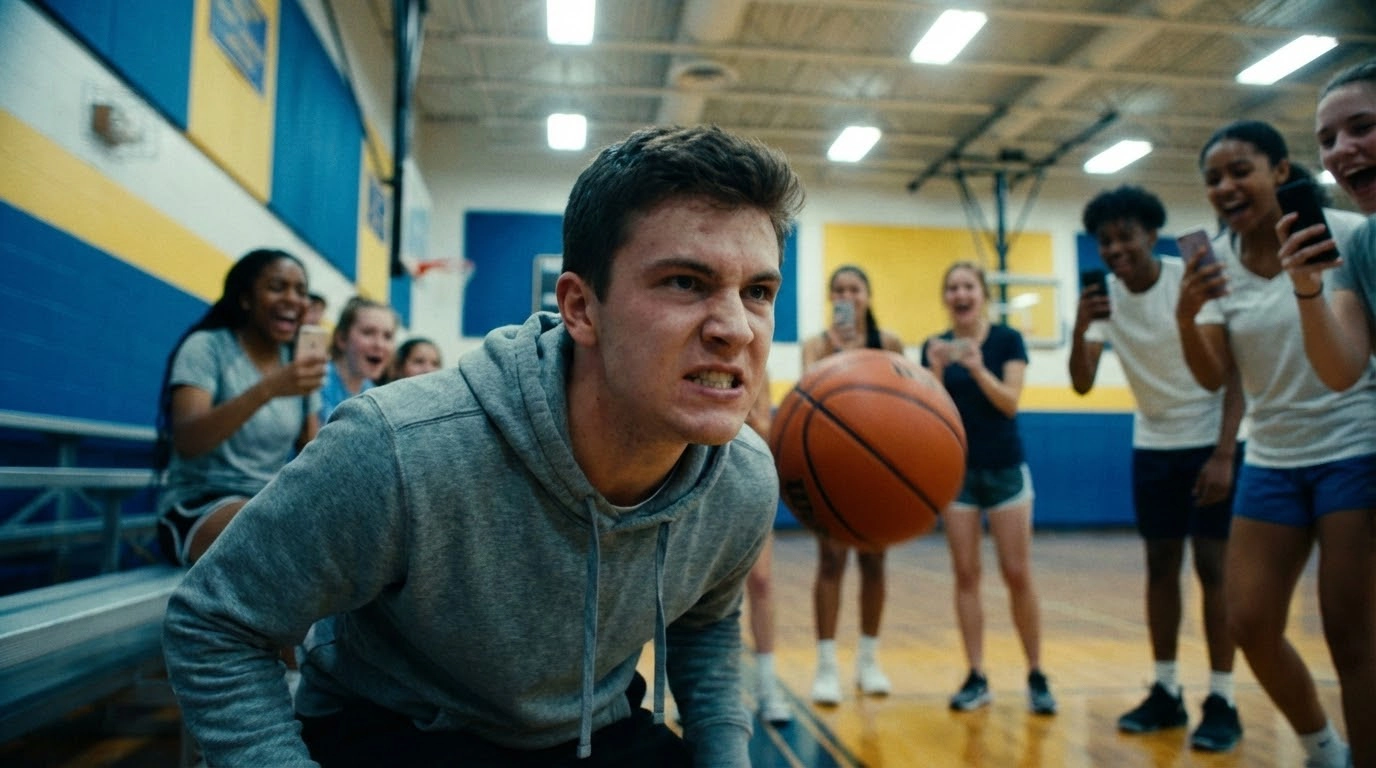
No one ever planned to hurt him that day. That was the truth he would understand much later.
The gym was bright, loud, ordinary, filled with the careless energy of teenagers who believed nothing truly mattered yet. Physical education class was never about sports for him. It was about surviving the noise, the looks, the unspoken hierarchy that everyone seemed to accept without question. He ran harder than usual that day, pushing his body until his lungs burned, not to impress anyone but to empty his head. When he finally sat down on the bench, breathing heavily, sweat dripping down his face, he thought he had earned a few quiet seconds. He didn’t see the boy across the gym lift the basketball.
He didn’t hear the laughter gathering before it happened. He only felt the impact when the ball struck his head, sudden and dull, followed immediately by the sound he knew too well: laughter that didn’t ask if he was okay, laughter that assumed he would stay exactly who they expected him to be. Phones came out. Someone said something clever. Someone always did.
The boy who threw the ball wasn’t angry, wasn’t cruel in the way movies portray villains. He was confident, admired, comfortable in a room that had already chosen sides long ago. That made it worse. He stayed seated. He didn’t look around. He didn’t touch his head. On the outside, he looked calm, almost detached, but inside something was tightening slowly, like a knot pulled a little more with every second the laughter continued. For years, he had believed that keeping quiet was strength, that patience would eventually be rewarded, that if he didn’t react, people would lose interest.
That belief had shaped his entire life. He avoided conflict, swallowed words, accepted small humiliations as the price of peace. Sitting there, with the echo of laughter bouncing off the gym walls, he understood something he had never allowed himself to admit: silence hadn’t protected him, it had trained others how to treat him. The realization didn’t come with rage. It came with clarity.
His breathing slowed. His jaw tightened. The noise around him felt distant, like it belonged to another room. When he stood up, it wasn’t dramatic. It wasn’t fast. It was deliberate, controlled, inevitable. The laughter didn’t stop immediately, but it faltered when people noticed his expression. There was no embarrassment on his face, no pleading, no need for approval. When he looked at the boy who had thrown the ball, his eyes were steady, unreadable, and when he spoke, his voice carried no anger, only certainty. “You’re making a very big mistake.” The gym didn’t explode into chaos. No one cheered. No one mocked him. For a brief moment, everything felt suspended, as if the room itself sensed that a line had been crossed and something had changed.
They didn’t yet understand what that sentence meant, or how far its consequences would travel beyond that day. He didn’t stay to explain himself. He didn’t demand an apology. He didn’t wait for anyone to understand. He walked away knowing that some moments don’t need a follow-up, only a decision. And that day, for the first time in his life, he chose not to disappear quietly